Short answer
A padel court project succeeds or fails on five decisions: the site and foundation, the steel structure and its wind rating, the glass and mesh enclosure, the playing surface and lighting, and protection from the weather. Settle them in that order, with a static calculation for your location, before you compare prices.
A padel court looks simple: a steel frame, glass, mesh, turf and lights. In practice it behaves like a small building, exposed to wind, rain and heavy daily use. Projects that run smoothly for years have one thing in common: the key decisions were taken in the right order, before anyone compared quotes.
These are the five factors our engineers review on every project.
1. Site, footprint and foundation
Everything starts with the plot. Check the usable area against the court’s needs: the 20 x 10 m playing area, a base of about 20.8 x 10.8 m for the structure, access openings, lighting posts and paths. If out-of-court play is allowed, add the safety areas beside the openings. The exact figures are in padel court dimensions.
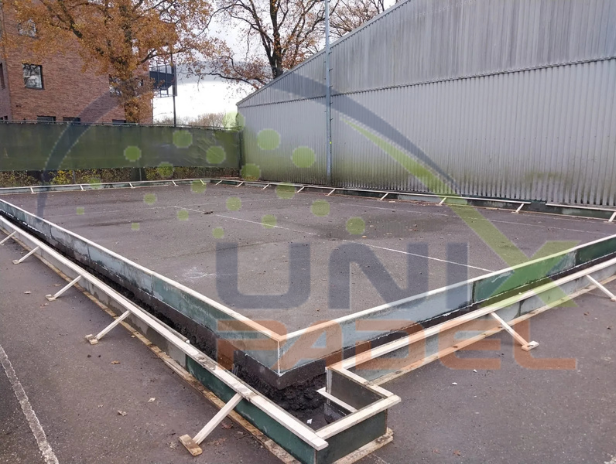
Then look at the ground. A conventional court needs a level slab (within 3 mm over 3 m) with a reinforced perimeter beam for the anchors and a drainage plan: a 1% slope on smooth concrete, or porous concrete that drains through itself. Our foundation guide compares concrete, porous concrete and asphalt bases.
Where excavation is impossible or too expensive (rooftops, car parks, leased land) the Flat Floor court stands on a pedestal system over any flat, stable surface, without a concrete slab.

2. Structure and wind load
A padel court carries large glass panels on a steel frame, so wind is the main structural load. The frame must stay rigid enough to keep the glass from vibrating and the anchors from loosening.
What to ask for:
- Steel grade and profiles: S355 structural steel; on Unixpadel standard courts, 100 x 50 x 2 mm columns and 100 x 50 x 3 mm beams.
- Corrosion protection: hot-dip galvanizing to ISO 1461 followed by electrostatic powder coating. In coastal or humid areas see coastal padel courts.
- Wind rating for your site: the Standard court withstands winds of 120–140 km/h with its three-pillar corners; the WP Challenge court adds corner reinforcement for very exposed sites.
- A static calculation: Unixpadel courts are supplied with static analysis approved by Istanbul Technical University (ITU).
The steel types guide explains why galvanized structural steel is the standard choice.

3. Glass walls and mesh
The walls are part of the game, so they must give the same rebound everywhere and stay safe when players hit them.
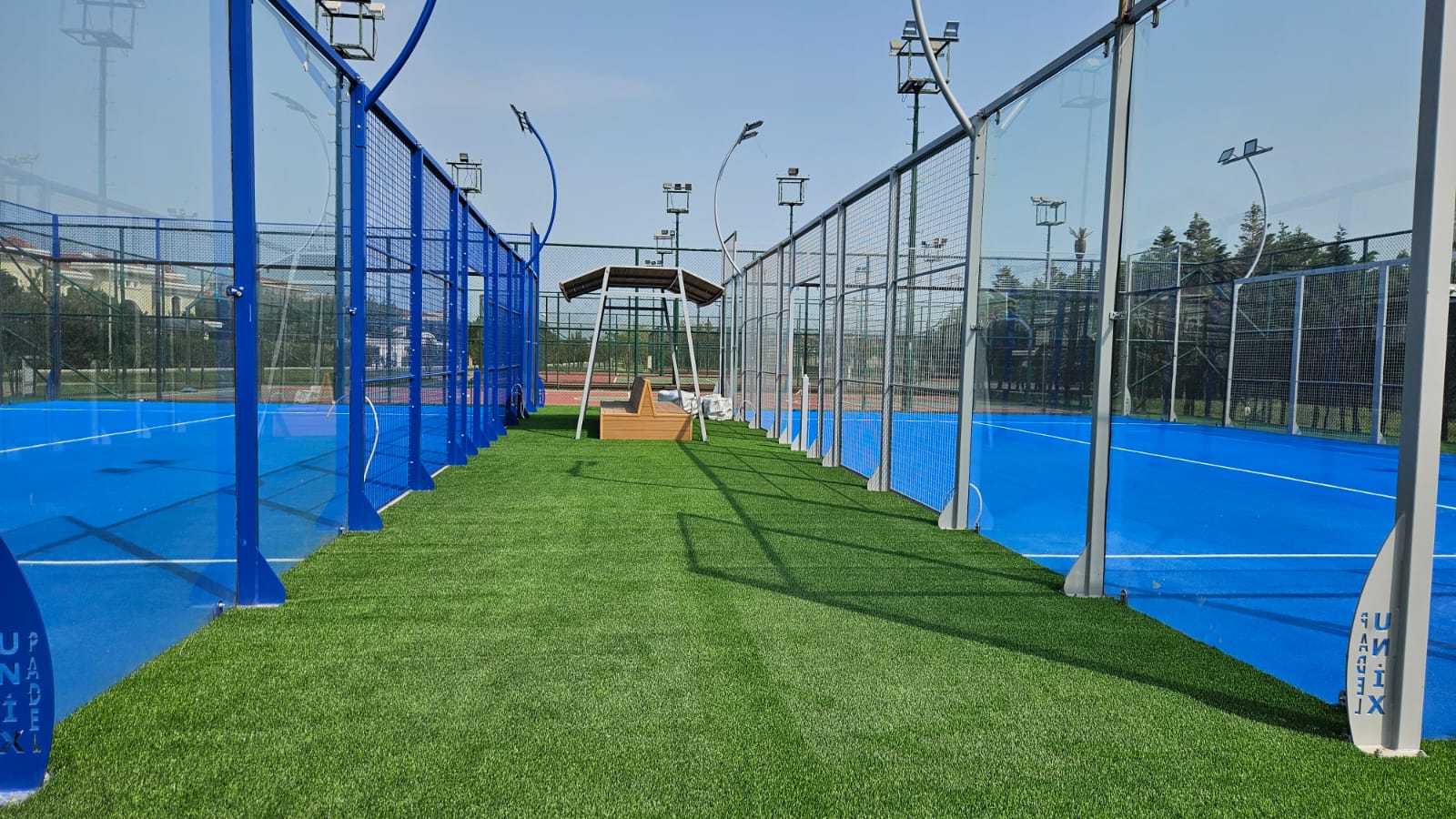
- Glass: tempered safety glass to EN 12150-1, 10 mm on standard courts and 12 mm on panoramic courts, fixed with rubber gaskets so glass never touches steel.
- Mesh: electro-welded steel mesh within the FIP limits for opening size and wire thickness, flush with the glass and with all weld points protected.
- Layout: stepped or straight side walls, both allowed by the FIP.
Details and quality checks are in the net and mesh quality guide.
4. Playing surface and lighting
The surface sets the speed of the game and how players’ joints feel after a session. Most clubs use sand-filled artificial turf; the FIP also accepts concrete and synthetic surfaces. Compare the options in padel court surfaces and browse Unixpadel turf systems.
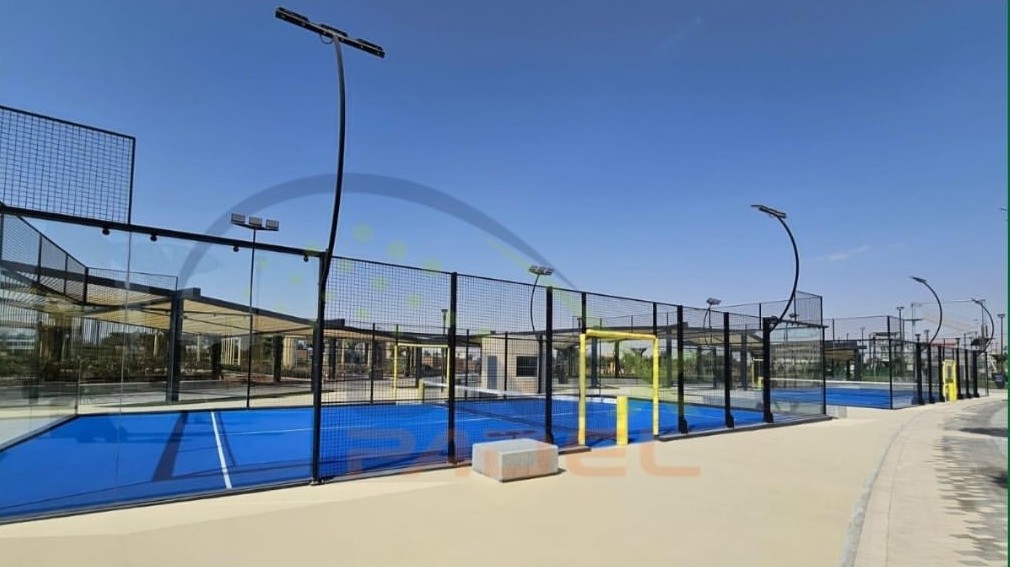
Lighting decides whether the court earns money in the evening. Plan LED floodlights that deliver an even 300–500 lux on club courts, mounted outside the playing area at least 6 m high, and aimed so they do not reflect into players’ eyes from the glass. Courts used for television need around 1,000 lux of vertical light.

5. Climate and canopy
Rain, strong sun and snow are the main reasons outdoor courts sit empty. In wet or very hot climates a canopy often pays for itself through steady bookings and longer turf life.
Options range from fixed membrane or sandwich-panel roofs to retractable systems; see Unixpadel canopies and innovative canopies. Indoors and under a roof, keep the clear height at 6 m minimum and preferably 8 m, as explained in ideal ceiling height.

What comes next?
With these five decisions made, the build itself is a sequence of well-known steps, described in how to build a padel court, and the budget can be set with confidence using how much a padel court costs.
Unixpadel’s design and consulting teams prepare site layouts, structural calculations and canopy options for single courts and multi-court clubs. Send us your plot and location to start.